How to Make a Public Bank Profitable from the Outset
On this page we will explore the legal, financial, and organizational structure of a Public Bank for your City, County, or State.
And a thorough look at How to make the bank profitable from the outset,
by RMPBI Chair, Earl H. Staelin, Attorney, with editorial assistance by Secretary, Michael Melio
17 Keys to Enact a Public Bank that Is Profitable and Beneficial from the Outset
Public Banks present a root solution in our collective efforts to establish Our Financial Independence and Sovereignty
1. Accountability. The public bank will be audited annually by an independent certified public auditor. It will also be audited annually by the government’s auditor or comptroller to ensure that it’s financial records are accurate and complete, the bank’s performance is consistent with its mission and governing statute. The audits will be reported on the public bank’s annual financial report and made accessible online.
2. The public bank should be managed solely by experienced professional bankers who make loans based upon adherence to the bank’s mission of productive lending in the community for industry, commerce, and agriculture, serving the public needs of the community, and credit worthiness to reasonably assure that each loan will be repaid. As with private banks, larger loans will be reviewed by qualified bankers at higher levels of the bank. In the case of the largest loans, the governing board makes a final review before approval.
3. The bank and all its operations will have strict rules to prevent conflicts of interest from adversely affecting its operations, whether it be corporate interests, wealthy individuals, non-governmental organizations, politicians, or family relationships. The BND and ATB Financial in Alberta provide excellent models for avoiding such conflicts in their management and in their making of loans and investments, for reporting conflicts of interest, preventively reviewing its operations for conflicts, and for eliminating and resolving such conflicts. (link to BND and ATB conflicts rules) As a result, BND for 107 years and ATB Financial for 88 years, have been well managed with virtually no scandals or fraud, with the exception of one incident of misuse of influence involving each of those banks decades ago. Both were resolved with a tightening of their respective regulations, which has successfully prevented a recurrence.
4. The bank will provide transparency for all its operation. The bank’s financial reports will be fully reported annually on its website, with details of its assets, liabilities, and net worth, and its income and expenses showing its profit or loss. In addition, like other governmental institutions throughout the country, the Bank of North Dakota’s Annual Reportsare reported online. This enables anyone to see what kind of loans the bank makes, to whom, and the results. See press release for 2025 report;https://www.einpresswire.com/article/923411903/bank-of-north-dakota-releases-2025-annual-report;
See also BND’s 2025 Annual Report: https://bnd.nd.gov/wp-content/uploads/2025-BND-Annual-Report.pdf
5. A public bank will have a governing board (board of directors) which may consist of public officials, or a mix of public officials and people with banking and community development experience. (see BND Leadership for example).
6. A public bank should have an Advisory board of stakeholders from the community, such as small and medium sized businesses, labor organizations, education institutions, community development organizations, minority community groups, and local financial institutions. The advisory board would meet regularly, such as monthly, give feedback, and make recommendations for new avenues of lending and operation of the bank to best serve the people. They will be trained to understand the bank’s mission, and their role in serving that mission when they join the advisory board.
7. The public bank, like BND, might most effectively be self-managed directly through its own Board of Directors following its own statute, rather than by the state banking board whose purpose, training, and expertise are solely developed to regulate private banks and whose regulations for private banks do not provide the same protections of the bank’s operations and deposits as a public bank’s. The public bank statute will be similar to state banking laws governing private banks but contain several necessary changes due to fundamental differences between a public bank and a private bank. It will not be regulated by the state banking board. BND was not chartered by and has never been regulated by North Dakota’s banking statutes designed to regulate private banks or by its state banking board. It has always been self-governed by its own board and statute. The board must follow the bank’s statute which assures responsible and safe lending. The statute contains several provisions that the state’s laws for chartering and governing private banks do not contain and that provide substantially greater safety of its deposits.
BND’s board consists of three top elected state government officials--governor, attorney general, and commissioner of agriculture. There is no need or additional benefit to be regulated by state banking law or the state board because those statutes and regulations were designed solely to regulate private banks that take retail deposits, not a public bank that is a banker’s bank, and that holds the deposits of the government entity that owns it.
Further, state laws and regulations governing private banks fail to adequately regulate and protect private banks. Most important, they do not prevent speculative lending to purchase existing assets such as real estate or stocks. They also do not restrict consumer loans. Asset purchases produce bubbles and crashes and consumer lending causes inflation. Such nonproductive lending and investing repeatedly causes major harm to our economy and our democracy.
It is beyond the scope of this paper to discuss in detail how regulation of private banks should be improved to adequately protect the banking system and make it safer for community banks and credit unions to flourish. However, it is a matter of great importance that should be addressed at the international, national, and state level.
Deficient regulation of private banks by FDIC and the Federal Reserve actually serves the profit maximizing goal of private banks, especially the largest ones. This is predictable because the Federal Reserve is owned by the largest banks and the largest banks have the most influence over FDIC policy. The Fed and other private central banks in turn own and control the Bank for International Settlements (BIS), which sets policy guidelines for private central banks. Deficient regulation also produces a recession about every six years, the Great Depression and the Great Recession being tragic examples. . Dr. Werner points out that historically, the Federal Reserve was responsible for the destruction of over 10,000 small banksduring the Great Depression, refusing them the necessary funds to remain solvent.
Public bank legislation requires lending solely for productive purposes, prohibits speculation in derivatives, and ensures low overhead (no branches, minimal ads, avoids excessive compensation, no taxes, no ATMs, avoids inappropriate fees and commissions). Therefore, a public bank modeled on the BND will provide more effective regulation to protect its bank deposits than the laws presently governing the chartering and regulation of private banks.
8. The public bank will not be a member of or insured by FDIC. The FDIC was established in 1933 in order to prevent “runs” on banks so as to prevent another Great Depression. A run occurs when depositors holding 10% or more of deposits, fearing the bank may fail, in a panic withdraw their deposits, making the bank insolvent. BND has never had or needed FDIC insurance. The state of North Dakota guarantees its deposits in the bank, which is sufficient. In 2019, when California passed AB-857 to authorize local public banks, it removed the provision exempting the bank from FDIC. That revision has contributed to the inability of any California city to start a public bank. See PBI and RMPBI websites with memo by attorney Earl H. Staelin about unnecessary roadblocks to establishing a public bank, particularly referring to the requirements for FDIC and collateral (see section 9 below).
a. It can’t experience a “run.” A PB has no need for FDIC insurance because it has one main depositor which by law keeps its deposits in the bank. Therefore, it cannot experience a run. It also helps prevent a run through its countercyclical lending which avoids bubbles and inflation. Thus, in a decline it increases lending to offset the decline and prevent recession. In 2007 and after BND stepped up its lending, and assisted stressed local banks. That was a big factor enabling North Dakota to be the only state to avoid recession. BND increased its lending up to 11.7 times its capital during the Great Recession, while banks in other states all reduced lending. BND had considerable assistance during this period from the Federal Home Loan Board which made a large supply of low cost loans available to BND, helping it to keep all local banks successfully operating and avoid any bank failures. BND experienced record profit during this period, reaching 26.5% ROE in 2007. See link to BND’s ROE 2001-2025.
b. FDIC insurance only covers $250,000 per account. A small public bank will probably have a minimum of about $20-30 million in deposits. The insurance would cover only a small fraction of its deposits (~1% or less). Therefore, the insurance would be virtually worthless, even if it spreads its deposits into multiple accounts to increase coverage.
c. FDIC’s capital adequacy rule does not provide effective regulation. FDIC regulation follows the Bank for International Settlement’s (BIS) Basel II capital adequacy rules, and eventually the pending Basel III requirement for “capital adequacy.” Richard Werner showed how the BIS-FDIC capital adequacy requirement does not prevent a bank from risky excess lending and collapse because banks can get around it by creating new money through new investors to increase its capital. Werner gave specific examples of such abuse by Credit Suisse and Barclays. BIS, which gives guidance to FDIC and the Fed and other private central banks, is controlled by private central banks and cannot be relied upon to protect local banks. FDIC and the Fed are also largely controlled by the big private banks and cannot be relied upon to provide safe regulation either. Global Research https://www.globalresearch.ca/the-federal-reserve-cartel-the-eight-families/25080
d. The capital adequacy rule could hinder the PB. The capital adequacy requirement could prevent the PB from saving community banks, credit unions, and CDFIs (local financial institutions or “LoFIs”) from collapse by buying their stressed loans.
Counter-cyclical lendingis an essential tool of a public bank because it allows it to increase lending in a downturn through its partnership loans with LoFI’s. BND has also made loans to allow local residents to buy a community bank that was up for sale to prevent its takeover by a large out of state bank. See Stacy Mitchell, Institute for Local Self-Reliance on the Bank of North Dakota
9. No collateral will be required for a public bank’s uninsured public deposits. The requirement of approximately 100% collateral for public deposits is necessary for a major private bank holding public deposits for a number of reasons. However, these reasons do not apply to a public bank modeled on BND due to its fundamental differences from a private bank. These reasons are as follows:
a. A run is impossible for a public bank modeled on BND, so collateral is unnecessary. First, as with FDIC insurance, the PB, having one depositor, cannot experience a run. BND has never been required to have or needed collateral. If it were ever needed, the bank and state are protected because the state guarantees its deposits in BND. Any bank modeled on BNDis immune to a run has absolutely no need for collateral. The fact the public bank is required to makesolely productive lending makes the argument even stronger.
California’s proposed statute AB-857 when initially filed did not require FDIC membership or collateral. However, a majority of its proponents, inspired by the prospect of being the first state in 100 years to establish a public bank, yielded on this issue so as to reinsert California law’s requirement for private depository banks to hold 110% collateral for uninsured public deposits. This provision arguably has been a key factor in preventing any city or county in California from coming up with a viable model for a public bank. This is due to the prohibitive cost of coming up with and continually maintaining 110% collateral for the uninsured deposits of a public bank. We recommend that this provision will need to be removed if public banks are to have a chance of success.
If any assurance of safety were deemed to be temporarily needed at the outset of a public bank, the Federal Home Loan Bank can provide a Letter of Credit in lieu of collateral for a fee.
AB-857 should best be amended as soon as possible to remove its roadblocks to public banks. Removing the FDIC and collateral roadblocks and making other changes to AB-857 suggested herein to facilitate public banks will require amending AB-857. Section 57607 (d) of the Act provides as follows:
The Commissioner of Business Oversight shall not issue a public bank license after the expiration of a period of seven years from the date on which the commissioner first promulgates regulations for the purposes of carrying out the commissioner’s duties under this division.
The California Commissioner of Business Oversight first issued those regulations on January 1, 2022. This date sets a deadline of January 1, 2029 to issue a license under the Act. However, section 57607 (c) provides that “the commissioner shall conduct a study of public banking in California within two years after the date on which the commissioner issued the 10th public bank license.” Since it appears that no licenses, much less ten, will be issued by that date, assuming the opinions stated herein are correct, it’s not clear on what date the report will be due or if a report is due. How can you do a report on public banking if no public banks exist on which to report? Rather than wait until 2029 or 2031 to see what will happen, it would make more sense to start as soon as possible to review and amend AB-857 to the extent necessary to make it fully effective as route to establish successful and financially sound public banks. This should include the alternative of establishing public banks in charter or “home rule” cities and counties, which is discussed below.
Advocates for public banks would be wise to hold firm and insist that the banking laws that have made the Bank of North Dakota an unqualified and safe financial success of incalculable value to the State of North Dakota and its community banks and credit unions be approved in California and other states.
b. A public bank has no conflict of interest with its government. A public bank is not handling “other people’s money” but in effect its own money and has no conflict of interest with its own government but a full alignment of purpose and therefore does not need collateral. The public bank’s sole purpose is to support its government and establish a strong and stable local economy for its people. It doesn’t need collateral to protect its own money. However, a large private bank as depositor for a government’s funds is handling other people’s money. Its primary purpose is to use those deposits to maximize its own profits for their shareholders’ benefit. This often leads the major bank depository to make large loans at higher risk, mostly outside the state, that provide no benefit to local citizens, and cause harm to health and the environment. Such loans are mostly non-productive and put the economy at risk through real estate and stock bubbles. They also make many nonproductive consumer loans which are inflationary. Major banks as depositories of public deposits, prefer to make loans wherever they can make the highest profit. That often leads to nonproductive, unsustainable, nonrenewable lending: for weapons and war, fossil fuels, toxic chemicals, big pharma, private prisons, and to inflate existing assets such as real estate and stocks. They also prefer to lend to large corporations, as Professor Werner discovered, leaving many local small and medium sized SMEs unable to get funding. These major banks, by moving our money out of state and depleting local government resources, increase the pressure to privatize public assets, further damaging our economy.
c. The cost of collateral is likely prohibitive. Just as important as the first two, the cost of 100% collateral for uninsured deposits is beyond the means of most governments and would make the bank less unprofitable if not unprofitable. As mentioned above, a properly designed public bank will hold all or most of the deposits of its government currently held by a major bank. The value of deposits of a start-up public bank holding all of its government’s deposits would probably be $20-30 million at a minimum for a small public bank. That is in addition to raising $20 million or more in initial capital. This reason is sufficient by itself not to require collateral for public deposits. Public banking efforts have reportedly been unable to proceed in part due to the inability to raise the funds to meet this requirement and its negative effects on the bank’s profitability.
d. The government will guarantee its deposits in the bank similar to the BND. Because the statutory design of the bank assures its financial safety and profitability this guarantee just adds an extra measure of safety, backed by the government’s power to tax if necessary. BND has never had to pay a penny to cover its deposits nor will a public on this model.
e. The large banks don’t actually provide 100% collateral. The large banks that hold most public deposits often pool their collateral within a state to back their public deposits. The public bank should not be required to provide something private depository banks don’t provide, much less something public banks don’t need and that would prevent them from getting started.
f. Derivatives would wipe out deposits in a major collapse. The 2005 Federal Bankruptcy Act gives derivatives priority in bankruptcy. A government with public deposits in a major bank is a general creditor whose deposits will be wiped out by the major banks holding derivatives. As mentioned above, in a major collapse the large banks’ shared collateral might not be enough to cover all the public deposits of the governments holding them.
g. The major banks profit from bubbles and recessions (the ‘business cycle’) and therefore have an incentive not to provide adequate regulation of private banks. The major banks and private central banks are the leading influence on bodies like the BIS, Federal Reserve, and FDIC in making regulations governing private banks. The major banks have the financial power to decide when a recession will occur by cutting lending. Then they sell out at top dollar before or as the crash starts. When the economy hits bottom they buy back failed banks and businesses for a fraction of their real value. They foreclose on billions in real estate and businesses as they did in 2008 and raise rent to unaffordable levels. They end up having more control over the economy and influence over government than ever before. This gives them an incentive to provide weak regulations that promote
h. Banking laws should require mostly productive lending to create new goods and services or “GDP” transactions. This avoids loans to purchase existing assets such as real estate, stocks, and commodities and loans for consumer purchases. Loans to purchase existing real estate might be deemed productive if they are to purchase a house as the sole home and residence of the purchaser. Or a loan to purchase a car would be deemed productive if it facilitates the borrower to hold a job. If private banks are to buy fixed assets such as real estate and stocks they should be required to use their own money and not credit creation of new money. The failure of banking laws to impose these restrictions on lending result from the fact that the big banks with the most influence in drafting those laws profit greatly from those regulatory defects.
i. The big banks can get bail-ins and bailouts. The largest banks know that if the economy crashes and they are at risk of failing, they can probably get a bail-in as authorized under the Dodd-Frank Act of 2010, or exert sufficient pressure to also get a bailout, creating a regulatory “moral hazard”. The costs those remedies will probably be paid in substantial part by other depositors or taxpayers. See PBI and RMPBI websites for details (links here). This adds to their incentive to perpetuate the “business cycle.”
10. The bank’s legislation should authorize the bank to raise its initial capital through bonds, pension funds, pooled funds or other reasonable and available sources that include borrowing.
Above, we explained why a public bank does not need FDIC insurance and should not be a member of the FDIC. Another reason not to be a member of the FDIC is that FDIC rules provide that a de novo bank should have Tier I capital of at least 8% equity capital. Tier I capital consists primarily of Common Equity Tier 1 (CET1) capital, in other words ownership of common stock in the bank. This rule prevents debt from being the source of initial capital. This rule makes sense for a de novo private bank because a new private bank usually requires about three years before it starts making a profit. The initial investors might be gone by then and not pay their debt.
However, a properly designed public bank as described herein is virtually guaranteed to make a significant profit in its first year and thereafter. Its profitability will be assured provided it begins by lending to its government such as by purchasing its bonds, and lending for infrastructure projects. That will produce immediate and substantial interest income. This is called Sovereign Lending in BIS regulations. BIS considers it the safest form of lending for a bank. The bank can lend directly, or through revenue bonds, general obligation bonds or COPs, or by refinancing existing obligations.
Sovereign lending gives the new bank steady income and stability while it gradually builds up its loans to small and medium-sized businesses through partnership loans with local financial institutions (LoFIs).
See Code of Federal Regulations, 12 CFR § 3.20 for Risk Weights to the Sovereign.
This approach makes the FDIC prohibition on debt as a source for capital a roadblock to the bank that provides no benefit. One of the California projects for a local public bank received a legal opinion from an independent nonprofit questioning their authority to raise capital from pooled funds. (NOTE: check and add details here).
A private bank is usually started by wealthy individuals or corporations who can afford to supply the minimum $20 million or so needed as initial capital. In contrast, a governmental body that is strapped financially, as most are in these times, will find it hard to come up with the initial capital needed to start the bank without taking it away from other essential services. A public bank, by requiring its loans to be productive to support “industry, commerce, and agriculture,” by helping assure low overhead (no branches, minimal ads, modest compensation, no taxes) will be virtually assured of consistent profitability. This eliminates any concern about using debt as a source of capital.
A portion of a government’s pension funds should also be seriously considered as a source of initial capital. Many pension funds, to maximize their returns, invest in “alternative investments.” These are hedge funds, private equity, real estate and stocks or other existing assets. (see David Sirota’s article here) The managers of these investments tend to be predators on the local corporations in which they invest. They usually pay themselves excessive salaries and benefits, cut staff, cut workers’ pay, cut services and their quality, and raise prices. It’s rightly called vulture capitalism. Their investments in real estate and stocks contribute to bubbles and recessions.
A significant portion of such predatory pension funds would be much better redirected as initial capital for a public bank. There it will produce much more benefit to the community and avoid those serious harms. For example, Colorado’s state pension fund, Public Employee Retirement Association (PERA) is worth about $60 billion, about 20% of which, or $12 billion is in alternative investments. If just 10% of PERA’s alternative investments, or $1.2 billion, were instead invested as capital for a State public bank, the public bank could lend up to ten times that or $12 billion to serve critical public purposes such as affordable housing, education, infrastructure, or transportation. The returns to PERA in interest would probably be about as good as the earnings before, and in addition the bank would provide much greater benefit to the community while significantly reducing harm. Pension funds around the country have invested large sums in unworthy alternative investments. (David Sirota citation)
Similarly, pooled funds and other sources should be authorized as a source of initial or additional capital.
11. Lending to its sovereign (Sovereign Lending) is an established way to ensure a substantial and profitable start to the bank.
A key reason why some legislators hesitate to support public bank legislation is their fear that the bank will fail. However, a public bank can easily and surely eliminate this fear by lending directly to its government or purchasing its debt or COPs. Banks create new money not only when they make loans but also when they purchase assets, including government debt or its equivalent COPs. (See this document on how a public bank can be profitable from the outset with Bond purchases. ). Lending to a government through bonds or COPs is considered very safe. In fact, it is considered so safe by BIS that its standard for lending to a government allows a capital adequacy ratio of 4% or less. A 4% capital adequacy ratio allows lending up to 20 or more times a bank’s capital. (see citation). A government that has a double A rating would probably qualify to lend 20 times its capital and could safely do so with loans to its sovereign.
A newly chartered private bank generally takes about three years to make a profit. A new public bank could be profitable in its first year with sovereign lending by purchasing and benefitting from the income on bonds or COP payments starting when the bank opens. Such lending typically covers infrastructure—housing, transportation, education, energy, and many other critical needs so one needn’t worry that initial lending won’t benefit the community. The public bank might be able to refinance at a lower interest rate and thus save the government money.
In 2015, the well-named “Brass Tacks” team of the public banking group in Santa Fe, NM wrote a five-year financial plan for a city public bank which included refinancing the bonds of Santa Fe that were eligible to refinance without penalty. The plan would have generated over $500,000 net income in its first year and much more in years two through five. (link) Daniel Metzger, who wrote the plan, pointed out that he found it difficult to see how the public bank would be profitable if it had to provide collateral for the bank’s tens of millions in public deposits. As explained above, a public bank should be exempted from the collateral requirement because the bank is owned by the depositor, and collateral is only needed for a large private bank holding our public deposits and would cripple a public bank.
12. Public banks will confine their lending to their own jurisdiction (The Regional Principle). The BND’s mission is to support lending in North Dakota for the benefit of citizens of North Dakota. The large banks prefer to lend primarily to large corporations, in part to benefit from economies of scale. As a result, most their lending is out of state. Large banks have little interest in local lending to SMEs. As Professor, economist, and banking expert, Richard Werner demonstrates, large banks lend to large firms, and small and medium sized banks lend to SMEs. Public banks generally prefer to lend locally to medium and small sized businesses. Public banks can best meet this need by confining their lending in the local community. Local small businesses tend to be starved for funding. By lending locally, the bank will better know its business customers and be able to better assist them to resolve particular needs to assure their success. Local lending or the “regional principle” has been a basic principle of the highly successful Sparkassen in Germany, founded some 200 years ago, as emphasized by Mark Cassell, author of Banking on the State – The Political Economy of Public Savings Banks(2021). The Sparkassen involve city-owned and nonprofit savings banks in about 1,500 cities in Germany. It is worth noting that none of the Sparkassen banks has failed in the past 200 years. Small companies account for 64 percent of new U.S. jobs; yet in most U.S. manufacturing sectors, productivity growth is substantially belowthe standards set by Germany, and many U.S. SMEs are not productive enough to compete with the cost advantages of Chinese and other low-wage competitors. Werner observes that Germany exports nearly as much as China does, although the German population is a mere 6% of China’s. German SMEs are world market leaders in many industries. See Ellen Brown’s article: https://ellenbrown.com/2021/12/24/the-real-antidote-to-inflation-stoking-the-fire-without-burning-down-the-barn/
13. A “feasibility” study should not be required to prove a public bank works. The BND, ATB Financial in Canada, the Sparkassen in Germany, and China’s public banks clearly demonstrate that public banks are very sound financially and provide great benefit. BND never did a feasibility study. Private banks are not required to do a feasibility study. Everybody knows a well-run private bank can be profitable. A private bank applying for a charter is required to present a business plan. What is needed for a public bank is draft legislation that provides a model and a business plan for a successful public bank. That will include features similar to those of BND that show how the public bank will make a profit under it laws. But the legislation should be drafted and led by a majority of persons knowledgeable about public banking.
Conventionally trained business and banking “experts” and regulators whom some politicians may insist on hiring for such a job may not understand that banks create new money “out of nothing,” how a public bank like BND as a banker’s bank is fundamentally different from a beginning private chartered bank, is immune from a run, and how collateral will be prohibitively costly and totally unnecessary. They may not understand why the public bank will be required to focus all its lending on infrastructure, industry, commerce, and agriculture, and thus solely on productive lending, or why productive lending and sovereign lending at its outset will assure profitability in its first year and thereafter. All of this requires true experts in public banking to work out and explain.
Public banking experts include Don Morgan, president of the Bank of North Dakota and economist Richard Werner, who has done public banking models for Florida, Michigan, and Tennessee. If requested, Werner has indicated he will draft business plans for states and cities for a reasonable fee. His previous reports exhibit the highest professionalism and understanding of public banking. Public banking experts will also explain how a restriction to productive lending will make the public bank considerably safer than the average private bank. That is because private banks are allowed to invest in existing assets such as real estate and consumer loans that cause bubbles, inflation, and crashes. Once advocates and legislators who thoroughly understand public banks and how to ensure their success draft legislation for a public bank and provide a five-year business model that follows the legislation and shows its profitability from the beginning, that should be sufficient.
A feasibility study by traditional private banking professionals will accomplish nothing for the and will waste considerable time and monoey for the reasons defined above. It is much wiser to educate and build support to pass the legislation which sets forth the means to obtain initial capital and deposits for the bank, the amount of money involved, and the laws governing the bank so as to ensure its safety, profitability and benefits to the community.to resolve particular needs to assure their success. Local lending or the “regional principle” has been a basic principle of the highly successful Sparkassen in Germany, founded some 200 years ago, as emphasized by Mark Cassell, author of Banking on the State – The Political Economy of Public Savings Banks(2021). The Sparkassen involve city-owned and nonprofit savings banks in about 1,500 cities in Germany.
14. Enlist the support of community banks, credit unions, and CFIs in advance. It is important before seeking to pass your legislation that you talk with the officers of community banks, credit unions, and CDFIs to gain their support. Some will be instinctively inclined to oppose the idea and think that the public bank will compete with them and take their business away. They need to be assured this will not be the case. Someone like Don Morgan would be valuable for this purpose. Once public bank supporters convince respected community bankers and credit union leaders of the advantages of working together to build a stronger banking system as in North Dakota which has had no bank failures for many years and has six times the national average of community banks per capita, and other benefits BND provides those leaders will help convince the skeptics among the local financial institutions.
15. Provide accurate information on the role of banks in creating money and its importance to public banking. Advocates should understand several things about money creation:
a. In 2014 and 2016, Richard Werner conducted the first-ever empirical studies of whether and how banks create new money at a real bank. The tests provided compelling and conclusive proof, respectively, that banks create new money in the form of a new deposit in the borrower’s account at the bank. The tests showed that the other two theories concerning banks and money, the fractional reserve or money-multiplier theory and the intermediation theory as usually defined are inaccurate.
b. The new deposit did not come from any other depositor’s deposit or from the bank’s reserves or from any other source. It was literally created “out of nothing.” The “deposit” is fictitious because nothing was deposited. Nonetheless, it is a liability of the bank to the borrower called a “deposit.”
c. The new “deposit” is counted by the Federal Reserve as new money and part of M1, which is included as a major part of the national money supply, M2.
d. In double-entry bookkeeping (also called double-entry accounting) the new deposit is balanced by an equal matching entry on the bank’s books of a new asset of the bank called a “Loan” which is based upon the borrower’s promise to repay the amount of the “loan” with interest.
e. For most bank loans the borrower must withdraw his new loan money from the bank and transfer it to his creditor such as a car dealer. The bank needs to have adequate reserves stored at the Federal Reserve to cover such transfer and other withdrawals. If it is likely to run short or runs short on occasion, the bank must make up the deposit, usually a temporary unsecured loan known as “Fed funds, at a low interest rate, or if that is not available, from the Fed discount window at a higher rate. A highly profitable public bank like the Bank of North Dakota should rarely if ever have such an issue. But if were to be caught short, it could rapidly repay the loan and restore its reserves. BND’s low overhead and productive and safe lending make it highly profitable, with new deposits coming in daily as payments of principal and interest on its loans in addition to new deposits from current or new depositors and from interest on its investments.
f. We should also understand that non-banks cannot create new money due to the “client money rules” which prevent them from taking deposits. Without being able to take “deposits” they cannot create the fictional “deposits” that constitute new bank “loans” and new money.
g. The growing support for Werner’ conclusions in recent decades such as from the Bank of England, Positive Money, and other authorities.
h. That private banks create 97% of our money, at least in the U.S. and most of Europe, and that this important power gives bankers the ability to generate enormous wealth and political power for themselves.
i. The power of private banks to create 97% of our money was never expressly or knowingly granted to private banks. Rather this “abandonment” by the people of their sovereign power to create money occurred almost entirely to ignorance on their part that they had such power or how to exercise it. The dearth of public knowledge that banks create money requires managing assets with caution, skill, and diligence to protect the beneficiary's interests. New money out of nothing persists only because the large private banks have effectively concealed their power to create new money for their own benefit as well as the fact that they use much of our hard-earned tax revenue deposited in their banks to do it. They hide this knowledge through their financial influence over professors of economics, business, banking, the media, government, and the public. Many if not a majority of business persons, bankers, and economists are even ignorant of whether or how banks create money. A survey in Frankfurt of over 1,000 people by Prof. Werner and his students showed that 84% thought either government or the central bank created most of our money. (see reference).
j. No law authorizes banks to create new money out of nothing by creating new deposits. On the other hand, no law prohibits it.
k. The power of banks to create new money grew out of the practice of goldsmiths about 500 years ago. They would receive deposits of gold from customers for safekeeping and lend out five or even ten times the value of the gold on deposit in paper receipts because they found that most of the time their customers would not take out more than about 10% of their total gold deposits.
l. Public officials have a fiduciary duty to handle the citizens’ money in their charge with the utmost care. Governments have unwittingly given away to private banks their power to create their own money for public good as opposed to private profit. an obvious breach of that duty. “Fiduciary duty” requires the “highest standard of care” for the beneficiary. This requires “managing assets with caution, skill, and diligence” to protect the beneficiary's interests. Giving away the sovereign power to create money for public interest to major private banks appears to violate that duty. While I’m not aware of a legal precedent applying fiduciary duty to money creation, the harm caused by giving away that power is so great that it would make an excellent test case as well as point in our favor.
16. In some states and cities, a local bank could be established under home rule without state legislation. In some states it may be difficult to persuade a state legislature to pass a state public bank due to the influence of the major banks who don’t want to lose their public deposits or their power. In those states, or in states that have home rule, it may be possible for a home rule city or county to enact a public bank without state legislation. In Colorado, in 2019 the state legislature’s legal arm, the Office of Legislative Legal Services (OLLS), wrote a legal opinion supporting the legality of a state public bank under the state constitution. In a follow-up email the OLLS wrote that its earlier legal opinion on the constitutionality of a state public bank also applied to a city or county public bank. It added that if a home rule city or county established a public bank by its legislation and confined its loans to its own jurisdiction, it could do so without state legislation.
Most people considering the idea of a local public bank assume that it would be chartered by the state banking board that licenses private banks and would have to abide by the state banking laws that regulate private banks. However, we believe that assumption should be questioned. The laws governing state chartered banks were all drafted solely with private banks in mind and never to regulate a public bank. The Bank of North Dakota has about seven features that are distinctly different and better for a public bank than the rules that govern the state’s private banks. The rules governing private banks are necessary and make excellent sense for private banks. However, the differences characterizing BND make equally eminent good sense because of the fundamental differences between it and private banks. These differences are covered extensively in the preceding paragraphs and may be summarized here:
1. Self-governing under its own board and statute and not the laws governing private banks
2. Holding the public deposits of its own government
3. No FDIC membership or insurance
4. No collateral for uninsured public deposits. The government will guarantee its own deposits.
5. The bank can raise its capital by borrowing.
6. The bank will confine its lending to its own jurisdiction or bordering jurisdiction that has no public bank.
7. The bank will focus its lending on productive loans that create new goods and services for industry, commerce, and agriculture.
Item 7 is a major improvement over the regulation of private banks because it can prevent inflation, bubbles, and recession, as well as bank and business failures. State banking laws do not provide this guidance or protection. As Richard Werner points out extensively in his writing and videos, the lack of such regulation over private banks is a serious weakness of federal and state banking regulation. As discussed above, the so-called “business cycle” or periods of boom followed by bust or recession is treated as a natural and inevitable feature of business and the economy by regulators such as the Federal Reserve, by economists, and by business groups. As shown herein, the business cycle is not inevitable and can be prevented by improved banking regulation. For example, the Federal Reserve and state banking boards, unlike the Bank of North Dakota and our proposed public bank on that model, do not restrict lending to productive purposes to produce new goods and services. Instead, they allow private banks to lend money to purchase existing assets such as real estate, stocks, and commodities and consumer loans. As mentioned above, this creates bubbles, inflation, and recurrent recessions. This destructive cycle can be largely if not completely avoided by requiring banks to make only productive loans. Unfortunately, the BIS and Federal Reserve do not impose such requirements despite the potential of such regulations to produce a stable economic system where the “business cycle” ceases to exist.
Like the Bank of North Dakota, a local public bank needs to be allowed these differences from state law governing private banks in order to be able to raise the money to get started, to succeed financially at the start and thereafter, and to best serve its community. It will also make the state’s banking system stronger, just as in North Dakota where there have been no bank failures for many years and the Bank of North Dakota played a major role in preventing any recession there in 2008.
The legal argument for those seven exceptions is that each of them is a purely “local matter” under home rule due to the fundamental differences of a public bank from a private bank, or, if the seven exceptions are deemed both a state matter and and local matter, the home rule variations do not conflict with the state laws where they are different, either in purpose or effect. Instead, they align with those purposes and improve the bank’s ability to achieve them.
About ten states have fairly broad home rule. Other states have partial home rule. In California, a number of cities and counties, called “charter” cities and counties, have home rule and may beable to exempt themselves from these provisions that were designed solely for private banks.
17. Most state constitutions do not bar a public bank. State constitutions generally restrict the state and political subdivisions in how they handle their money in relation to private corporations and private parties. The primary concern of these provisions was to protect states and political subdivisions from investing their money with businesses controlled by private parties who took unreasonable risks, resulting in the total loss of the government’s investment without recourse. This concern arose especially in the mid-1800s with privately controlled railroads that went bankrupt, causing the state or city to lose its investment and incur a large debt. Many states then enacted constitutional provisions designed to prevent such losses. The concern was not about public banks. Several independent legal opinions have examined these provisions and have concluded that they do not bar a public bank. These should be examined to see the provisions involved and how case law and legal analyses show that the constitutional provisions in question do not prohibit a public bank.
Colorado OLLS Legal Opinion on the Constitutionality of a State Public Bank
California: The San Francisco Legal Department; David, Polk, Wardwell, LLP (a national law firm); and the San Francisco Committee for Civil Rights each independently concluded that California’s constitution does not prohibit a public bank. (NOTE: add links to the others unless still considered confidential)
The restrictions in the constitutional provisions are necessary and appropriate to regulate government interaction with a private corporation that controls the operation and its risk. However, when such interactions are under government control of the operation and are designed to serve a public purpose such interactions have uniformly been found not to violate the state constitution. Legal cases and legal opinions from respected sources support the assertion that such constitutional provisions would not prohibit such relationships with a public bank when public risk is limited and when the relationship is dedicated to serve a public purpose.
Since the constitutional provisions in question are quite similar from state to state, we recommend reading the above opinions and having a lawyer in your state review them and prepare a legal opinion directed to the comparable provisions in your state and prepare a legal memorandum to determine whether they are constitutional.
Draft by Earl H. Staelin, Attorney and chair, Rocky Mountain Public Banking Institute Legal Advisor, Public Banking Institute and Public Banking Associates
With editorial assistance from Michael Melio, Secretary RMPBI and Communications and IT Director of Public Banking Institute
Creating a Public Bank with Legislation
Private banks have Charters that define the reason for their existence.
A Public Bank, by contrast, defines its mission, enumerates its powers, establishes its jurisdiction, structures its governance, oversight, transparency, and accountability, and more through the legislation enacted by a City, County, or State government.
Capitalization
The bank will need startup capital to pay for salaries, office space, computers, software and hardware, and other incidentals in the first year of operation.
See this document on how a Public Bank can be profitable from the outset by purchasing Bonds .. by Attorney Earl H. Staelin

Understanding Sovereign Lending
Sovereign Lending is when a bank extends credit and loans to the “sovereign”, any elected city, county, regional, or state government.
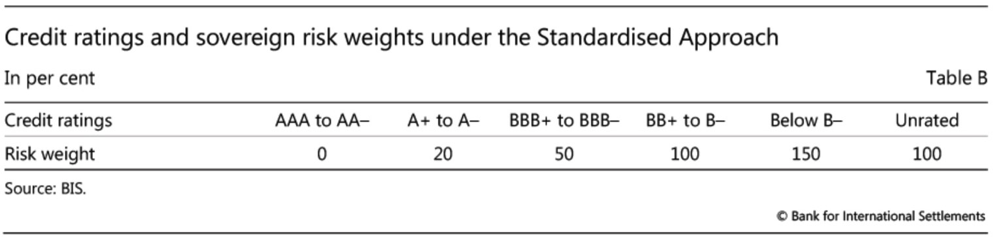
According to the Bank for International Settlements (BIS) Basel III accords, lending to a sovereign is the safest and least risky investment that a bank can make. The reasoning is very sound, as a sovereign city, county, or state is highly unlikely to fail, has a regular flow of tax revenue, and the government has many assets to secure its loans.
The first chart below shows the curve of Lending Ratio vs Risk Weight. As the Risk Weight approaches 0% the Ratio of Lending $1 increases substantially such that $62 of Capital can be loaned out for One Dollar of Capital for a Sovereign with a Risk Weight of 20%. This factor is one of the key elements assuring that a Public Bank, lending to its government (sovereign) can be very profitable from the outset.
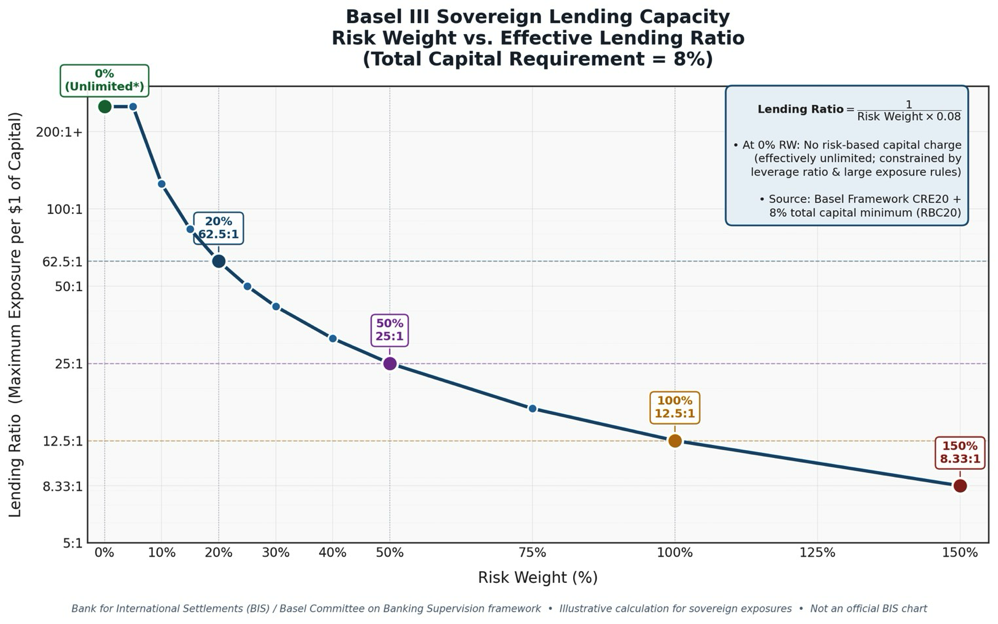
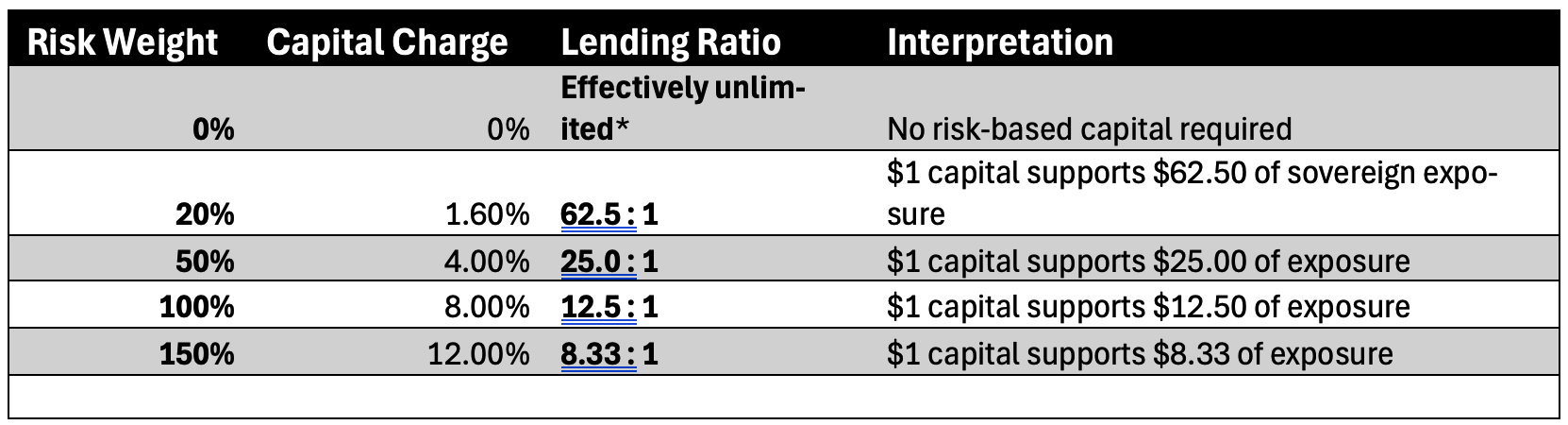
For example, in Colorado, Denver, Boulder, and Colorado Springs all have at least an AA+ (S&P) or AA1 (Moodys) Credit rating, making the lending ratio for a bank, according to Basel III, virtually unlimited, as the Risk Weight is near or at 0%.
For Commerce City, Colorado, with a Credit Rating of A+ (S&P), a bank lending to the City has a Risk Weight of 20% or a lending ratio of $62 for every $1 of capital.